Pool painting often looks deceptively straightforward from the outside. The pool is faded, stained or simply tired, so the obvious next move seems to be choosing a fresh colour, buying a product labelled for swimming pools and setting aside a weekend to begin preparation. For many DIY renovators, that feels like the logical order. In reality, the most important decision may have been made too early.
Before a coating system can be chosen sensibly, the renovator needs to understand what the new coating will actually be asked to bond to. That means looking beyond the colour of the pool and establishing the underlying surface, whether the pool has been coated before and, where possible, what type of coating is already present. Those facts shape the preparation route and narrow the choice of suitable coating systems. Starting with the product instead can force the rest of the project to fit a decision that was made without enough information.
This is why successful pool renovation is better treated as a diagnosis before it becomes a painting job. The tin is near the end of the decision process, not the beginning. Once that distinction is understood, product choice becomes far less confusing because preparation, compatibility and application stop being separate questions and start forming one connected system.
The Product Is Not the Starting Point
Walk into a coatings supplier with a faded pool in mind and it is natural to ask, “What pool paint should I use?” It sounds like a product question, but it is really a surface question. A better starting point is: “What do I have now?” Until that is reasonably clear, choosing between coating systems is premature because the condition and history of the pool influence what happens next.
A bare or newly prepared surface presents a different decision from a pool carrying an existing coating. A previously painted pool also raises another question: what type of coating is already there? In BG Coatings’ pool range, for example, 2K epoxy and 1K chlorinated rubber are distinct coating systems. They should not be treated as interchangeable tins of coloured material simply because both are intended for pool applications. Compatibility with what is already on the surface matters, and an existing coating can restrict the sensible options available for recoating.
This is the first useful rule for a DIY renovator to remember: identify first, specify second. The aim is not to become a coatings chemist before painting the pool. It is simply to gather enough information about the substrate and existing coating to avoid making the product decision backwards.
That mental shift also changes the way a project is budgeted. Instead of asking how many litres of a favourite colour to order, the renovator first works out what system the pool requires, whether primer forms part of that system, how the surface needs to be prepared and only then how much material will be needed. Colour remains important, but it comes after the technical route has been established.
Three Decisions That Are Really One Decision
Preparation, compatibility and product choice are often discussed separately, which makes pool painting sound like a checklist of independent jobs. In practice, they are closely linked. The existing surface determines the preparation required; preparation determines what the new coating will actually be applied over; and that prepared surface must then be suitable for the selected coating system.
Consider a homeowner looking at an older concrete pool that has already been painted. The surface may be faded and patchy, with areas where the previous coating still appears sound and others where it has deteriorated. The homeowner might be attracted to an epoxy system because they like the idea of using a two-pack coating. But before that preference becomes a purchase, the existing coating needs to be considered. If the previous coating is unknown, the correct question is not “Which colour should I order?” but “What exactly am I proposing to put this new system over?”
The same logic applies in the opposite direction. Someone may see chlorinated rubber as an appealing maintenance option for a pool that has previously been coated, but the existing coating still matters. A new coating does not arrive on a blank canvas simply because the surface has been washed and emptied. What lies underneath remains part of the coating system, unless preparation has genuinely taken it out of the equation.
A useful way to think about this is that every coat inherits the history beneath it. Surface material, old coatings, previous repairs and preparation all become part of the environment in which the new coating must perform. That is why compatibility cannot be treated as an afterthought once the tins are sitting beside the pool.
The Existing Coating Can Be the Most Important Clue
One of the hardest situations for a DIY renovator is a pool that was painted years ago with no surviving paperwork, leftover tins or reliable record of the product used. The surface may simply look “blue”, but colour tells you virtually nothing about the type of coating beneath it. That uncertainty should be recognised as a technical question rather than brushed aside.
This does not mean every homeowner must identify an old coating by sight. In many cases, that would be unrealistic. What matters is recognising when the existing coating is unknown and seeking the appropriate technical guidance before selecting the next system. A vague memory that the previous owner “had the pool painted” is not the same thing as knowing whether the existing material is compatible with the coating you intend to apply.
The distinction becomes especially important because BG Coatings offers both epoxy and chlorinated rubber pool coating systems. They serve different situations, and the route from an existing coating to the next one depends on what is already there. Where compatibility is uncertain, guessing because one product seems easier to apply or because a particular colour is preferred can create unnecessary risk before preparation has even started.
For a homeowner, painter or property manager inheriting an older pool, the most valuable information may therefore be historical rather than visual. Old invoices, product labels, previous contractor records or remaining tins can all help establish what was used before. Even a photograph of the previous product may be more useful to the product-selection process than another photograph of the faded pool itself.
Preparation Only Makes Sense After the System Is Known
DIY renovation advice often begins with preparation, and rightly so, because coatings depend heavily on the surface beneath them. The problem is that “prepare the pool properly” is too vague to be useful if the coating route has not yet been determined. Preparation is not a generic ritual that automatically makes every product compatible with every surface.
The preparation process needs to lead toward a defined end point: a surface suitable for the coating system that will follow. That is why choosing the system and planning preparation belong in the same conversation. Primer requirements can also form part of that decision. For BG Pool systems, whether a primer is relevant depends on the surface and coating route rather than being something that should simply be added to every project by default.
A renovator can therefore save themselves considerable confusion by resisting the urge to begin sanding, cleaning or stripping simply because the pool is empty and work can finally start. Before physical preparation begins, the project should have a clearly understood coating pathway. That does not mean every microscopic detail must be decided months in advance, but the renovator should know what type of surface they are working with, what is presently on it and which coating system they intend to apply.
This also prevents a common form of wasted effort: preparing the pool in one direction and then discovering that the chosen product requires a different route. The strongest DIY planning sequence is not “buy, prepare, paint”. It is “identify, choose the system, confirm the preparation route, then buy and apply”.
A Better Diagnostic for the DIY Renovator
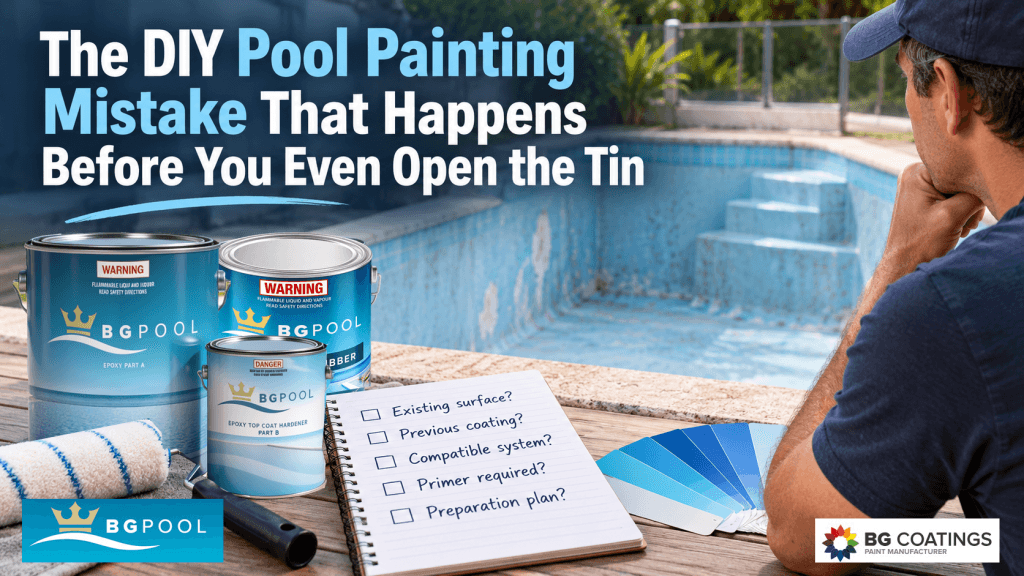
The easiest way to avoid the mistake is to turn the first stage of the project into a short diagnosis. Before comparing colours or calculating how many tins will be required, the renovator should be able to answer a small group of practical questions.
- What is the pool surface made from?
- Has the pool been coated previously?
- If so, what coating system is already on it?
- Is the existing coating sound, deteriorated or partly missing?
- Which BG Pool coating system is being considered for that existing surface?
- Does the proposed system require a primer or another specific preparation step?
These questions are deliberately simple. Their purpose is not to provide a complete technical specification but to expose uncertainty early, when it can still be resolved without wasted product or duplicated work. If the answer to a critical compatibility question is “I don’t know”, that is useful information. It means the next action should be investigation or technical advice, not opening a tin and hoping the answer becomes obvious during application.
For contractors and property managers, the same diagnostic becomes a valuable way to standardise decision-making across different pools. Two properties may both have faded blue swimming pools, yet their coating histories and substrates may be completely different. Treating them as visually similar projects can hide the factors that actually determine the coating route. A consistent diagnostic process makes it easier to document what is known, identify what is uncertain and avoid choosing products based purely on appearance.
Once you’ve identified the existing surface and coating system, the next practical question is how much material the project may require. The BG Pool Paint Calculator uses your pool dimensions or known water capacity, coating system and existing surface to estimate the internal paintable area and likely product quantity. If the existing coating is unknown, the calculator flags that uncertainty rather than treating it as automatically compatible
Why Buying the Paint First Feels So Reasonable
There is a behavioural reason this mistake is common. Buying the coating feels like progress. It turns an untidy renovation problem into something concrete: the colour has been chosen, the order has been placed and the project feels underway. Diagnosing an old surface, by comparison, can feel like delay because it introduces questions at exactly the moment the homeowner wants answers.
Product pages can also encourage people to think in terms of individual tins rather than coating systems. A renovator sees epoxy pool paint, chlorinated rubber pool paint, primer and colour options as separate purchasing choices. The more useful perspective is to see them as possible components of a route determined by the particular pool. The job is not to select the most appealing individual product. It is to establish the correct pathway from the surface that exists today to the finish you want at the end.
This distinction is especially important for enthusiastic DIY renovators because confidence with tools does not automatically answer a compatibility question. Someone may be perfectly capable of cleaning, mixing and applying a coating carefully yet still begin with the wrong assumption about what should go over the existing surface. Good workmanship cannot compensate for a coating decision that should have been reconsidered before application began.
The practical lesson is that a slower first decision can produce a much smoother project. Ten minutes spent gathering the right information about the pool can be more valuable than an hour spent comparing colours before the system is understood.
Treat the Pool as a System, Not a Tin of Paint
A finished pool surface is the visible result, but the real project sits underneath it. The substrate, any existing coating, the preparation performed, any primer required and the final coating system all connect. Looking only at the coloured topcoat is like judging a roof by the last layer applied while ignoring everything supporting it.
For the DIY renovator, this way of thinking removes much of the mystery. You do not need to memorise every possible coating combination. You need to know which questions determine the route. Start with the physical pool, establish its surface and coating history as far as reasonably possible, then choose a system that fits those conditions and follow the relevant technical information for that system.
If there is uncertainty, resolve it before ordering simply because the pool is empty, the weather is favourable or the weekend has been set aside. The costliest part of a DIY coating project is not necessarily the price of the tin. It can be committing labour and material to a decision that was never properly established in the first place.
Before you ask, “Which pool paint should I buy?”, ask the question that comes first: What exactly am I painting over?
Need Help With “The DIY Pool Painting Mistake That Happens Before You Even Open the Tin”?
Choosing the right coating system is only part of the job. Good preparation, compatibility and application decisions matter too. If you need product guidance for your project, BG Coatings can help you work through the options before you get started.
Talk To BG Coatings