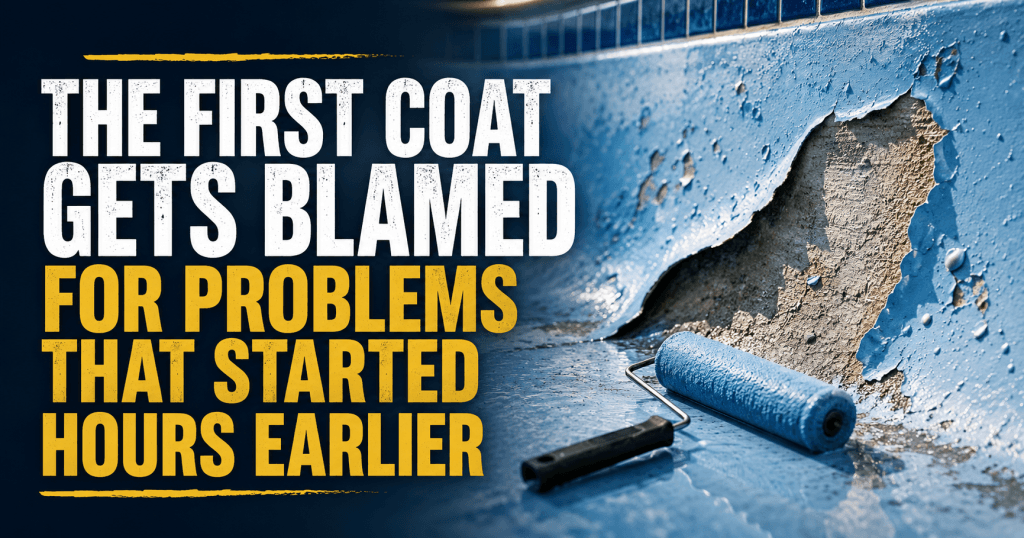
The First Coat Gets Blamed for Problems That Started Hours Earlier
When epoxy pool paint begins to bubble, lift or peel, the first instinct is often to blame the paint. The coating must have been faulty. The mixture must have been wrong. Perhaps the first coat was too thin, the product was difficult to work with, or the paint simply did not perform as expected. That reaction is understandable because the visible failure appears in the coating. What is much harder to see is the chain of events that may have begun well before the epoxy was mixed.
A pool surface can look ready and still contain exactly the conditions that make reliable adhesion difficult. Fine contamination can remain after cleaning. Sections of an old coating can appear solid while being weakly attached underneath. Moisture can remain in the substrate or in areas that have not dried as expected. A surface may be clean in the everyday sense yet still lack the condition needed for a new coating system to form a dependable bond.
This is why successful pool painting requires a different way of thinking about preparation. The question is not simply whether the pool looks clean enough to paint. The more useful question is: what, if anything, is still sitting between the new epoxy and the sound surface it needs to bond to? Once that becomes the standard, preparation stops being the inconvenient stage before painting and becomes part of the coating system itself.
The failure you see may not be where the failure started
A coating failure is visually persuasive. If a new layer of epoxy comes away from the surface, the new layer is what the owner sees curling, blistering or detaching. That naturally directs attention toward the material that has just been applied. Yet the location of the visible problem does not necessarily identify its original cause. The new coating may simply be revealing a weakness that already existed underneath it.
Think of adhesion as a chain rather than a single bond. The new epoxy must adhere to whatever surface is immediately beneath it. If that surface is old paint, then the old paint must also remain firmly attached to whatever lies below that. If there is contamination between layers, loose material, chalky residue or another weak interface, the entire system becomes dependent on that weakness. Applying a strong new coating does not strengthen an unstable layer underneath it.
This distinction matters because it changes the diagnosis. When paint comes away with fragments of the old coating attached to its underside, for example, the new epoxy may have bonded perfectly well to the material beneath it. The failure may have occurred further down in the existing coating system. From the homeowner’s point of view the new paint has peeled, but technically the weakness may have been inherited rather than created by the new coat.
That gives pool owners a useful rule to remember: a new coating is only as secure as the weakest surface it is attached to. It is simple, but it explains why preparation cannot be judged by appearance alone.
Clean enough to look good is not the same as clean enough to coat
There is a major difference between making a swimming pool visibly clean and preparing it as a coating surface. Everyday cleaning is usually judged by what can be seen. Dirt disappears, obvious grime is removed and the surface looks fresh. Coating preparation has a different objective. Its purpose is to remove or correct anything that could interfere with the physical bond between the existing surface and the material being applied over it.
That distinction becomes important because some of the most troublesome contaminants are not dramatic. A surface may carry residue from previous cleaning products, accumulated oils, fine dust created during preparation or remnants of degraded material that are difficult to notice once the surface has dried. If the pool is assessed simply by standing back and asking whether it looks clean, those conditions can be missed.
The practical question is therefore not, “Can I still see dirt?” It is, “Is there anything left on this surface that the epoxy will be trying to stick to instead of the sound material underneath?” That small shift in language changes the purpose of the inspection. Dust is no longer merely untidy. Loose residue is no longer cosmetic. Anything that remains between the coating and the substrate becomes part of the adhesion problem.
For a DIY pool owner, this can be one of the least intuitive parts of the project. Painting feels like the productive stage because the transformation becomes visible immediately. Preparation feels slower because hours of work may leave the pool looking only marginally different. Yet those apparently uneventful hours may have more influence on the eventual result than the few minutes in which a particular section receives its first coat.
Old paint can hide a problem beneath a perfectly ordinary surface
Previously painted pools deserve particular attention because the new epoxy may not be bonding directly to the original pool surface at all. It may be bonding to an older coating system whose history is unknown. That coating might have been applied years earlier, repaired in places, exposed to different conditions or subjected to previous preparation that the current owner knows nothing about.
This creates a deceptively simple problem. If old paint is present, it becomes part of the foundation for everything applied above it. A section can appear intact when viewed casually yet contain edges, patches or layers that are no longer firmly attached. Painting over those areas does not reset the system. It merely adds another layer to it.
Imagine a Perth homeowner repainting an older pool. Most of the existing coating appears reasonably sound, but several small areas are flaking. The obvious flakes are removed, the pool is cleaned, and the remaining surface looks uniform enough to continue. The temptation is to assume that because the visibly loose pieces are gone, the preparation is finished. But the more useful question is whether the surrounding coating is genuinely sound or whether the visible flakes were simply the easiest part of a broader adhesion problem to detect.
That is why preparation needs an investigative stage, not merely a cleaning stage. The owner is looking for boundaries between sound and unsound material. Obvious peeling is easy to identify. Less obvious weakness requires closer attention because the new coating cannot compensate for an old layer that is already losing its hold.
Moisture can turn an apparently ready surface into an uncertain one
Moisture introduces another difficulty because it can be present without making the entire pool look wet. A surface may appear dry across most areas while moisture remains in particular sections, pores, cracks or low points. The important principle is not that every moisture-related coating problem has the same cause. It is that surface readiness cannot be judged solely by whether standing water has disappeared.
For epoxy application, preparation therefore includes allowing the relevant surfaces to reach the condition required by the coating system being used. That means treating drying as a technical stage rather than simply the period between washing the pool and starting to paint. The manufacturer’s preparation and application instructions matter because different coating systems can specify particular requirements for surface condition, mixing, timing and application.
This is also where impatience can become expensive. Once the pool looks clean and the weather appears favourable, the desire to begin painting is strong. Each additional hour spent waiting can feel like lost time, particularly for a homeowner trying to complete the job over a limited number of days. But starting early does not actually save time if the underlying condition is not ready to accept the coating.
A useful mental model is to separate visible dryness from coating readiness. They are not automatically the same thing. The surface should be judged against what the coating system requires, not against the owner’s understandable desire to move on to the interesting part of the job.
Surface preparation is really an adhesion audit
The most effective way to think about preparation is as an adhesion audit. Instead of working through cleaning and preparation tasks simply because they appear on a list, the pool owner keeps asking what each task is trying to eliminate. That creates a more intelligent process because the preparation work is tied directly to the reason the coating needs it.
An adhesion audit focuses attention on several practical questions. Is the material underneath the new coating sound? Is anything loose, dusty, chalky or unstable? Is there contamination that could remain between the epoxy and the intended surface? Has the pool reached the surface condition required for the coating system? Are there areas that look different from the rest and therefore deserve closer inspection before painting begins?
These questions are more useful than a generic declaration that the pool has been “prepped”. Preparation is not a binary event. A person can spend many hours working on a pool and still overlook the one condition that matters most. Conversely, careful inspection can identify a small problem before it becomes buried beneath an entire new coating system.
This also helps explain why following product-specific preparation instructions is more valuable than copying a simplified routine from another project. Two pools that appear similar from above may have very different surfaces underneath. One may be bare and sound, another may carry several generations of old paint, while another may contain repairs or isolated areas requiring additional attention. The right preparation is determined by the surface that actually exists, not by the appearance of the finished pool the owner hopes to achieve.
The most dangerous moment is when the pool finally looks ready
There is a psychological trap near the end of preparation. Once the pool is empty, cleaned and visibly transformed, the owner feels as though the difficult work has been completed. Paint tins are waiting, the surface looks dramatically better than it did at the beginning, and applying colour feels like the natural next step. This is precisely the moment when a final inspection has the highest value.
Before opening the epoxy, it is worth looking at the pool again with a different objective. Do not inspect it for cleanliness or appearance. Inspect it for reasons not to paint yet. Look for material that still seems loose or questionable, residue remaining after previous work, areas that differ noticeably from surrounding surfaces, or sections whose condition is uncertain. Any uncertainty is easier to investigate while the substrate is exposed than after it has been covered.
That approach is not about searching endlessly for perfection. It is about distinguishing between cosmetic imperfections and conditions that could interfere with adhesion. A stain that merely looks unattractive is a different issue from material that is sitting between the new coating and the surface. A slight colour variation in old paint is different from an edge that is lifting. The skill is not making every square centimetre look identical. It is identifying anything that prevents the new coating from meeting a stable, properly prepared surface.
For homeowners, this final check can also prevent a common reasoning error: “I have already spent two days preparing this pool, so it must be ready.” Time invested does not prove readiness. The surface itself does.
Before you blame the epoxy, look underneath it
The most valuable lesson in a failed pool coating is that the visible layer should not automatically become the accused layer. Peeling, bubbling or poor adhesion can be the final expression of a problem that began long before the first coat was applied. The coating may simply be the point at which that hidden weakness finally becomes visible.
For anyone preparing to repaint an epoxy pool, the practical advantage of understanding this is substantial. It changes preparation from a series of chores into a search for potential bond-breakers. Cleaning has a reason. Removing unstable material has a reason. Allowing the surface to reach the required condition has a reason. Inspecting old coatings has a reason. Each task is protecting the same thing: the connection between the new epoxy and a sound surface underneath it.
The best final check therefore comes before the lid comes off the tin. Stand at the edge of the prepared pool and forget, for a moment, about colour, rollers and the satisfaction of seeing the first coat go on. Ask one question instead:
What is the epoxy going to be sticking to?
If the answer is anything other than a sound, appropriately prepared surface that meets the coating system’s requirements, the painting stage has started too soon.
Need Help With “The First Coat Gets Blamed for Problems That Started Hours Earlier”?
Knowing what needs fixing is one thing. Getting it fixed properly is another. If you need help choosing the right BG Coatings pool paint system, preparing the surface or working out what products you need, BG Coatings is here to help.
Get Help From BG Coatings