A swimming pool is often described by one impressive number: how many litres it holds. A typical backyard pool might contain 35,000, 45,000 or 60,000 litres of water, and that figure is useful when dealing with filtration, water treatment and chemical dosing. It is also an easy number for an owner to remember. When the time comes to repaint the pool, however, that familiar figure can become surprisingly misleading.
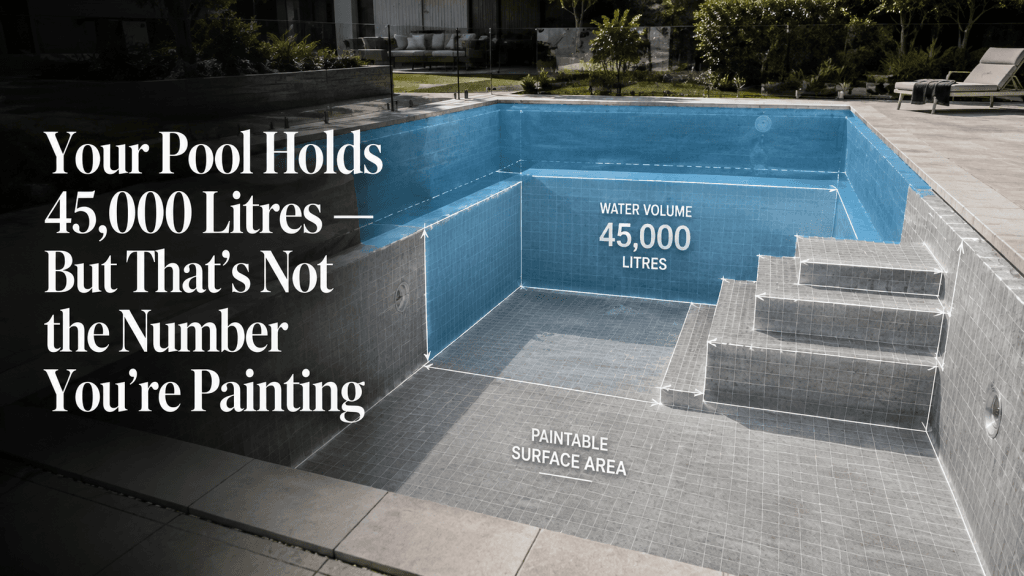
Paint is not being applied to the water volume. It is being applied to the physical surfaces surrounding that volume: the floor, the long walls, the end walls, steps, ledges and other areas that form the pool shell. Those surfaces are measured as area, normally in square metres. A pool may hold tens of thousands of litres while presenting a very different number of square metres to be prepared and coated.
That distinction sounds simple, yet it sits behind one of the most common mistakes in early pool-paint planning. Owners understandably start with the number they already know — pool capacity — when the number that matters for paint quantity must be calculated from the pool’s dimensions and shape.
The useful rule is straightforward: litres describe what is inside the pool; square metres describe what you have to paint.
Volume and surface area answer two different questions
Pool volume measures three-dimensional space. In a simple rectangular pool, it is influenced by length, width and depth. Increase any of those dimensions and the pool can hold more water. That is why volume is expressed in cubic metres or litres: one cubic metre of water represents 1,000 litres.
Paintable area is a two-dimensional measurement. Instead of asking, “How much space is inside this pool?” the question becomes, “How much actual surface will a roller, brush or other application method need to cover?”
For a basic rectangular pool, that means thinking separately about the floor and the walls. The floor has a length and width. Each long side has a length and depth. Each end has a width and depth. Real pools may add complications such as a sloping floor, shallow and deep sections, entry steps, benches or unusual curves, but the principle remains unchanged: every coated surface contributes area.
This is why converting litres directly into paint quantity does not work. Litres and square metres are not two different ways of expressing the same measurement. They describe fundamentally different things.
A 45,000-litre pool does not have a universal paintable area any more than a 200-square-metre house has a universal internal volume. The relationship depends on the proportions and geometry of the structure.
Two pools can hold similar amounts of water and have different areas to coat
Consider two hypothetical pools with broadly similar water capacity. One is relatively compact and deep. The other is longer, wider and shallower. Both may contain a similar volume of water, but the second pool can expose substantially more floor and wall area because its volume is spread across a larger footprint.
That is the key mental model. A body of water can be packaged in different shapes.
Imagine a simple rectangular pool that is 9 metres long, 4 metres wide and averages about 1.25 metres deep. Its approximate water volume would be 45 cubic metres, or 45,000 litres. Ignoring steps and other details for the moment, its horizontal floor alone covers around 36 square metres. Its two long walls add approximately 22.5 square metres, and its two end walls add another 10 square metres. The basic internal surface therefore already approaches 69 square metres before allowing for variations in the floor, steps, ledges or other features.
Now imagine trying to estimate paint from the phrase “45,000-litre pool” alone. None of those surface dimensions is contained in that number. The water capacity tells you the volume enclosed by the shell, but it does not tell you how that shell is distributed between floor and walls.
This is also why two owners can truthfully say, “My pool is about 45,000 litres,” and still require different quantities of coating. Their pools may have different lengths, widths, depths and profiles.
The floor is only part of the job
Another easy mistake is to look at a pool from above and unconsciously treat its footprint as its paintable area. If a pool measures 8 metres by 4 metres, it is tempting to think in terms of roughly 32 square metres. That may describe the plan area of a flat rectangular floor, but a pool is not a patio.
Its walls matter.
In a relatively deep pool, the vertical surfaces can add a considerable amount to the total area. A nine-metre side wall with an average depth of 1.4 metres represents more than 12 square metres by itself. There are two long sides, plus the end walls. A sloping floor may also have a slightly greater actual surface area than its simple overhead footprint suggests.
Then there are the details that make real swimming pools different from neat textbook boxes. Steps introduce horizontal treads and vertical risers. Built-in benches create additional faces. Curved sections need to be treated according to their actual geometry rather than forced into an inaccurate rectangular estimate.
The aim is not to turn a homeowner into a surveyor. It is to make sure the estimate is based on the surfaces that will actually receive coating rather than on a convenient but unrelated water-capacity figure.
Think of the empty pool as a room
One of the easiest ways to understand paintable area is to stop picturing the pool full of water.
Picture it empty.
Standing inside an empty pool, the problem becomes much more intuitive. There is a floor under your feet, walls around you, ends in front of and behind you, perhaps a set of steps, and possibly changes in level. Those are the surfaces that need to be measured and considered.
In that sense, estimating pool coating is conceptually closer to estimating paint for a room than calculating chemicals for a swimming pool. When painting a room, nobody asks how many cubic metres of air the room contains. They measure the walls and other surfaces being painted. The same distinction applies below the waterline.
This empty-pool test is particularly helpful when checking an online estimate or your own measurements. Ask yourself: Have I accounted for every significant surface I would physically touch if I walked through the empty pool?
If the calculation includes only length multiplied by width, something is probably missing. If it starts with litres and never asks about the pool’s dimensions, it is answering the wrong question.
Average depth helps, but pool shape still matters
Many residential pools are not a uniform depth from one end to the other. A shallow end may gradually slope towards a deeper section, meaning there is no single wall height that perfectly represents the entire pool.
For preliminary estimating, average depth can be a useful simplification where the pool shape allows it. If one end is approximately one metre deep and the other two metres deep, an average of around 1.5 metres can provide a reasonable starting point for certain simple geometric calculations. It should not, however, be mistaken for an exact description of every surface.
The more irregular the pool, the more important it becomes to recognise where simple dimensions stop being reliable. Freeform pools, pronounced curves, large entry platforms, extensive steps and unusual deep-end profiles can require more careful measurement than a straightforward rectangular shell.
This is not a flaw in the calculation method. It is simply geometry. A basic pool can be represented with a few dimensions; a complex pool contains more individual surfaces.
For an owner gathering information before buying coating, the practical objective is to provide enough accurate dimensional information for the paintable area to be estimated sensibly rather than trying to force every pool into the same formula.
Paint quantity starts with area, then moves to the coating system
Once the approximate surface area is known, it becomes possible to move to the next stage: determining how much coating the particular project may require. That stage must be based on the requirements and stated coverage information for the coating system being considered.
This is an important separation of tasks. Geometry answers the first question: how many square metres are there? Product information answers the second: what quantity of the selected coating system is required for those square metres?
Keeping those questions separate prevents several assumptions from creeping into the estimate. Different coating systems should not automatically be treated as interchangeable, and an existing pool surface may need to be identified properly before a suitable system is selected. The condition and type of the substrate, the existing coating and the specific product instructions all matter to the wider project.
The square-metre calculation therefore does not tell you which coating to use. What it does is give you the correct physical basis on which a coating quantity can later be calculated.
A useful order of thinking is:
- identify the pool’s actual length, width, depths and significant features;
- estimate the internal floor and wall area in square metres;
- identify the surface and existing coating correctly;
- then use the relevant coating system’s current product guidance to determine quantity.
Starting with “the pool holds 45,000 litres” skips the most important measurement in that sequence.
Why getting the distinction right matters before the pool is empty
For most homeowners, the value of a better estimate is not mathematical elegance. It is project planning.
Pool recoating involves a sequence of decisions, and coating quantity is one of the things that is better resolved before work is under way. Once a pool has been emptied and the surface is being prepared, discovering that an estimate was based on water volume rather than actual coating area is an avoidable complication.
Measuring properly also makes conversations with a coating supplier more useful. Saying that a pool holds roughly 45,000 litres gives some sense of its overall size, but providing its length, width, shallow and deep-end measurements and details of significant steps or ledges gives far more relevant information for estimating surface area.
The same measurements also make it easier to sense-check a result. If somebody produces an area figure that appears remarkably close to the pool’s top-down footprint despite substantial walls and depth, that should prompt another look. Likewise, a calculation that changes dramatically merely because the stated water capacity changes — while the physical dimensions remain the same — deserves scrutiny.
The practical question is always the same: what physical surfaces are actually receiving paint?
The number to take to the paint calculation
Knowing the litre capacity of a pool remains useful. It simply belongs to a different part of pool ownership. Water volume matters when dealing with the water itself. Coating calculations begin with the shell surrounding it.
Before estimating pool paint, put the litre figure aside and record the dimensions that describe the surfaces: length, width, depth profile and any significant steps, benches or other features. From those measurements, establish the approximate number of square metres that will actually be coated. Only then should that area be matched with the current guidance for the appropriate coating system. To work this out before ordering your paint, BG Coatings provides a free Pool Paint Calculator. You can start with either your pool volume or your pool dimensions, and the calculator helps turn those measurements into a practical paint estimate Size
If there is one rule worth remembering, make it this:
You do not paint the litres. You paint the square metres.
Need Help With Your Project?
If you need help choosing the right BG Coatings paint or coating for your project, talk to BG Coatings about the surface you are working with and the product options available before you order.
Calculate Your Pool Paint Here